
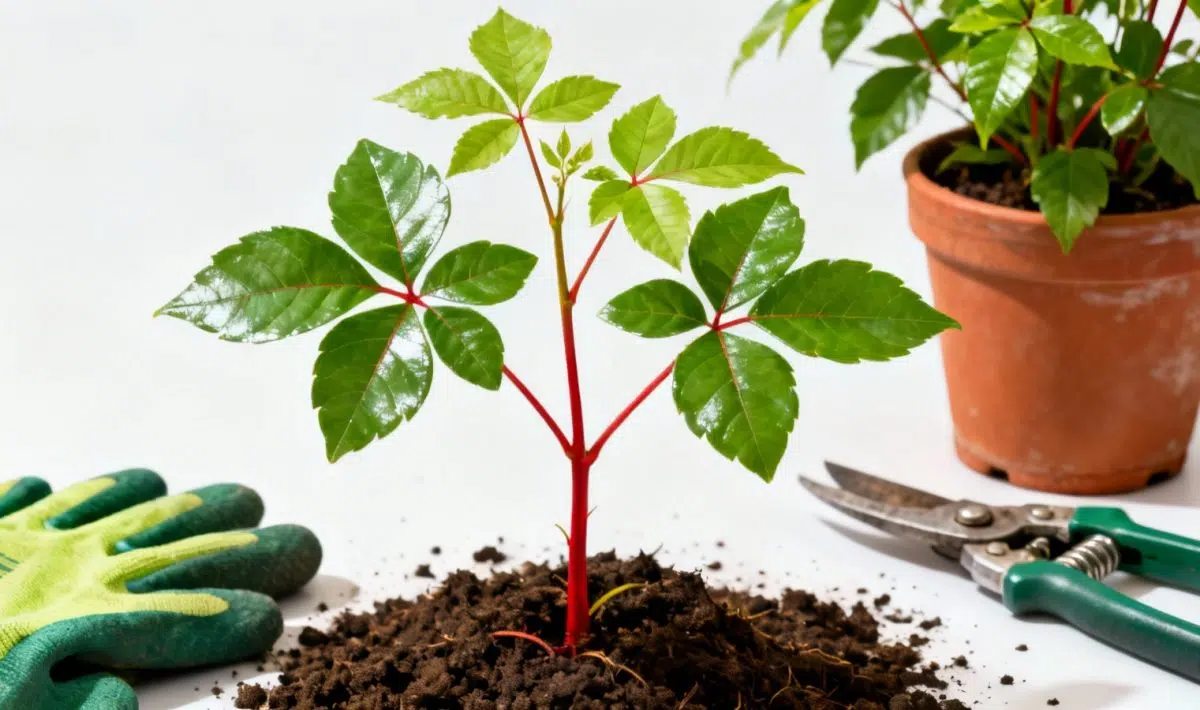
Poison ivy (Toxicodendron radicans) stands as one of North America’s most notorious plants, and frankly, it’s got quite the reputation for good reason. This climbing vine packs a serious punch with its toxic compound urushiol, yet it plays a fascinating role in our ecosystems that many gardeners overlook.
Understanding poison ivy characteristics
The classic “leaves of three, let it be” saying exists for a purpose. Poison ivy displays distinctive three-leaflet compound leaves, with the center leaflet typically longer than its companions. During spring, these feuilles emerge with a glossy green appearance, often tinged with reddish hues that catch the eye.
As seasons shift, the plante transforms dramatically. Summer brings deep green foliage, while autumn showcases brilliant reds and yellows that rival any ornamental vine. The stems develop a characteristic hairy appearance with aerial roots that help this vigorous climber scale trees and structures with remarkable efficiency.
Small yellow-green fleurs appear from May through July, measuring roughly a quarter inch across. These inconspicuous blooms eventually develop into waxy white fruits that persist through winter, providing crucial food for various animaux including birds and small mammals.
The toxic nature of urushiol
Every part of poison ivy contains urushiol, a potent allergen that causes severe dermatitis in most humans. This oily substance remains active even on dead plant material, making dried vines just as dangerous as living ones. The reaction typically develops within 12 to 48 hours of contact, beginning with intense itching and progressing to painful blisters.
What makes urushiol particularly troublesome is its persistence. The substance can remain active on tools, clothing, and pet fur for months. Even tiny amounts – less than what you’d find on a pinhead – can trigger a reaction in sensitive individuals.
Interestingly, about 15% of the population shows natural immunity to urushiol, though repeated exposure can sometimes overcome this protection. Animals generally remain unaffected, which explains why poison ivy thrives in many natural habitats without causing ecological disruption.
Cultivation considerations and habitat requirements
While most gardeners aim to eliminate poison ivy, understanding its growing preferences helps with both identification and removal strategies. This adaptable plante thrives in diverse conditions, from dense woodlands to open fields and coastal areas.
Poison ivy tolerates various soil types but shows preference for well-draining, slightly acidic conditions. It grows equally well in full sun or partial shade, though tends to develop more robust climbing habits in shadier locations where it can use trees for support.
Water requirements remain modest once established. The plante demonstrates remarkable drought tolerance, similar to how care and propagation of apricot trees requires minimal irrigation after the initial establishment period.
In optimal conditions, poison ivy exhibits rapid growth rates, potentially reaching 60 to 150 feet in length when climbing mature trees. This vigorous expansion makes early detection and management crucial for property owners.
Propagation methods and spread patterns
Poison ivy employs multiple propagation strategies that contribute to its widespread success. Seeds dispersed by birds represent the primary long-distance spread mechanism, while underground rhizomes enable local colony expansion.
The waxy white fruits provide essential winter nutrition for over 60 bird species. These feathered allies inadvertently transport viable seeds across vast distances, establishing new populations in suitable habitats. Seeds require cold stratification and may remain dormant for several seasons before germinating.
Vegetative propagation occurs through extensive rhizome networks that can survive beneath ground for years. Even small root fragments left after removal attempts can regenerate entire colonies, making mechanical control challenging without persistence.
Unlike controlled cultivation methods used for growing and caring for cucumbers, poison ivy requires no human intervention to establish thriving populations.
Safety protocols and protective measures
Working around poison ivy demands serious protective equipment and careful planning. Long-sleeved shirts, long pants, gloves, and eye protection form the basic safety ensemble. Some professionals recommend disposable coveralls for extensive removal projects.
Timing plays a crucial role in safety. Autumn and winter offer optimal removal windows when reduced sap flow minimizes urushiol concentration. However, dormant vines remain toxic, requiring continued caution throughout the year.
Tool decontamination prevents accidental exposure later. Rubbing alcohol effectively dissolves urushiol residues on metal surfaces, while washing with hot, soapy eau removes contamination from clothing and skin. Never burn poison ivy debris, as smoke carries urushiol particles that can cause dangerous respiratory reactions.
Treatment and first aid measures
Swift action following suspected exposure significantly reduces reaction severity. Immediate washing with cool eau and dish soap helps remove urushiol before skin absorption occurs. Avoid hot eau initially, as it can open pores and worsen penetration.
Rubbing alcohol applied within 10 minutes of contact dissolves remaining urushiol. Follow alcohol treatment with thorough soap and eau washing to remove dissolved toxins. Clean under fingernails carefully, as this area often harbors contamination.
For established reactions, cool compresses and calamine lotion provide symptom relief. Over-the-counter antihistamines help manage itching, while severe cases may require prescription corticosteroids. Much like specialized care techniques for tips for Madagascar dragon tree care, proper treatment requires patience and consistent application.
Ecological benefits and wildlife value
Despite its toxique nature toward humans, poison ivy provides significant ecological benefits. The dense foliage offers nesting sites for birds, while the persistent fruits supply crucial winter nutrition when other food sources become scarce.
Over 60 bird species consume poison ivy fruits, including woodpeckers, thrushes, and various songbirds. Small mammals like chipmunks and squirrels also rely on these lipid-rich fruits for energy storage before winter dormancy.
The plante supports numerous insect species that feed on its feuilles and fleurs. These insects, in turn, provide food for insectivorous birds and other predators, creating complex food web relationships within forest ecosystems.
Erosion control represents another ecological benefit, as poison ivy’s extensive root systems help stabilize soil on slopes and disturbed areas. This stabilizing effect proves particularly valuable in région where human activity has disrupted natural vegetation patterns.
Management and control strategies
Effective poison ivy management requires understanding its biology and growth patterns. Mechanical removal works best for small infestations, but requires multiple treatments due to the plante’s ability to regenerate from root fragments.
Cut vines at ground level during dormant seasons, then treat emerging shoots with targeted herbicide application. This approach minimizes chemical usage while maximizing control effectiveness. Repeated cutting eventually depletes root energy reserves, leading to colony decline.
Systemic herbicides containing glyphosate provide effective control when applied to actively growing foliage. However, careful application prevents damage to desirable vegetation nearby. Unlike managing beneficial jardin species such as cultivating common sowthistle effectively, poison ivy control prioritizes complete elimination over cultivation.
Biological control through competitive planting shows promise in some situations. Establishing dense groundcover or desirable climbing vines can eventually outcompete poison ivy for light and space resources.
Prevention remains the most effective long-term strategy. Regular property inspections allow early detection when control efforts prove most successful. Understanding poison ivy’s preferred habitats helps property owners focus monitoring efforts on high-risk areas.

Allan is a lifelong gardening enthusiast who still gets excited when the first seedlings pop up in spring. With a deep love for nature and a hands-in-the-soil approach, he shares practical tips, plant discoveries, and clever tricks picked up over years of digging, planting, and observing. Whether you’re a new gardener or have a shed full of tools, Allan writes like a neighbor who’s always happy to swap cuttings and stories over the fence.
You can find more about Allan’s work on Malt or connect with him on LinkedIn.


